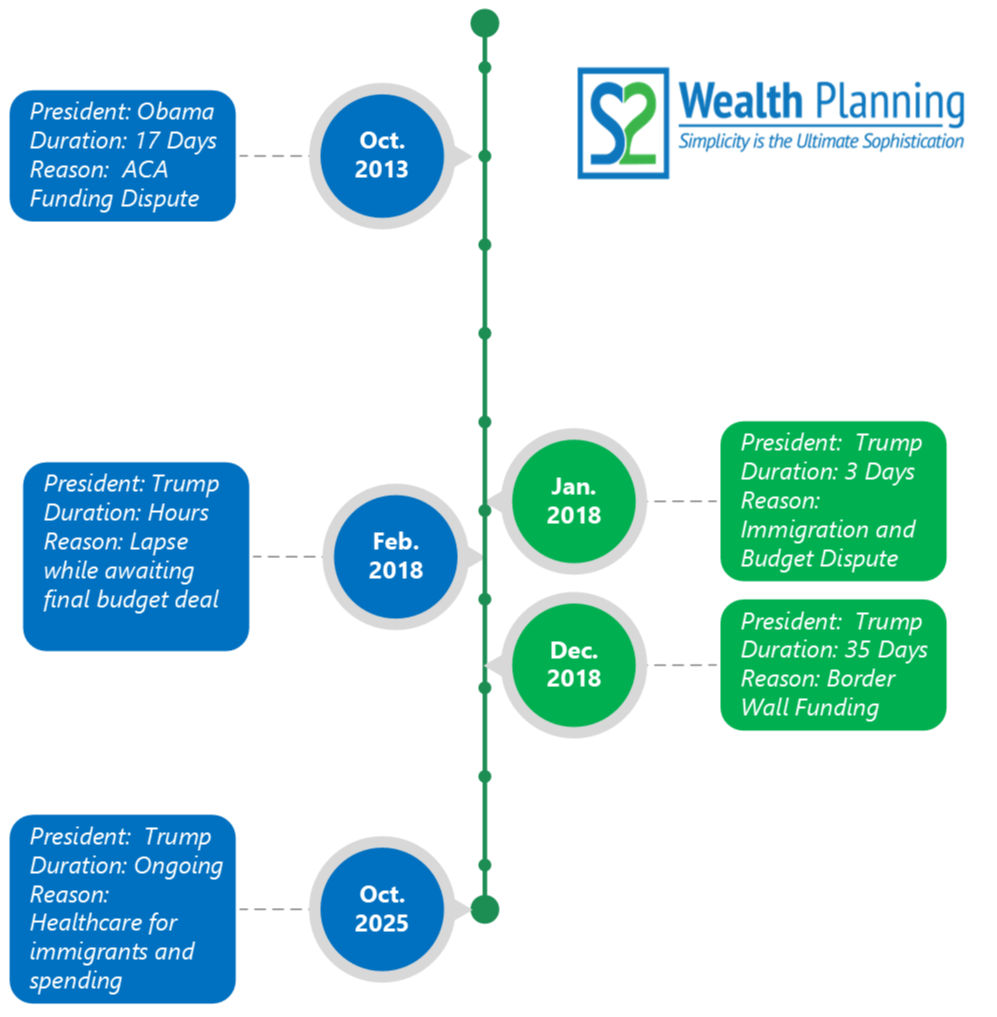
What happens when the government shuts down and how common is a shutdown? Unless the government employs you or you are planning a trip to the Smithsonian, you might not even notice. There have been 21 shutdowns over the past 50 years that occurred under seven different presidents from both parties. How might this affect you? Social Security checks will arrive as scheduled, and air traffic controllers will continue to guide flight operations safely. All essential employees will continue working (albeit without pay), while government offices are likely to furlough non-essential employees. Post-shutdown, to this point, back pay has been provided to non-essential government employees for their time on furlough. Why does the government shut down? Actually for many underlying reasons, but the main reason is the fiscal year for budget spending is October 1 through September 30 of the following year. If a full-year spending bill is not passed, a continuing resolution can provide temporary funding of the government for a short period of time. If the funding issues are not resolved, Congress can pass additional continuing resolutions to extend temporary payment as well. How does a shutdown end? Though a simple majority is required to pass a continuing resolution through the House of Representatives, 60 votes are needed to advance a continuing resolution to vote. Continuing resolutions can be used to buy time to iron out differences or compromise to get agreement across the aisle for a full appropriations spending bill. Should investors be concerned? In recent years, the shutdowns have become a favorite tool of the minority party to label the party in power as out of touch or irresponsible. The frequency of recent government shutdowns has caused most consumers to point it out as typical "DC Dysfunction" and markets to have a "meh" response.
Whatever happens, we'll be right here to help you through it. If you have any questions, please don't hesitate to reach out. |

Understanding a Government Shutdown